
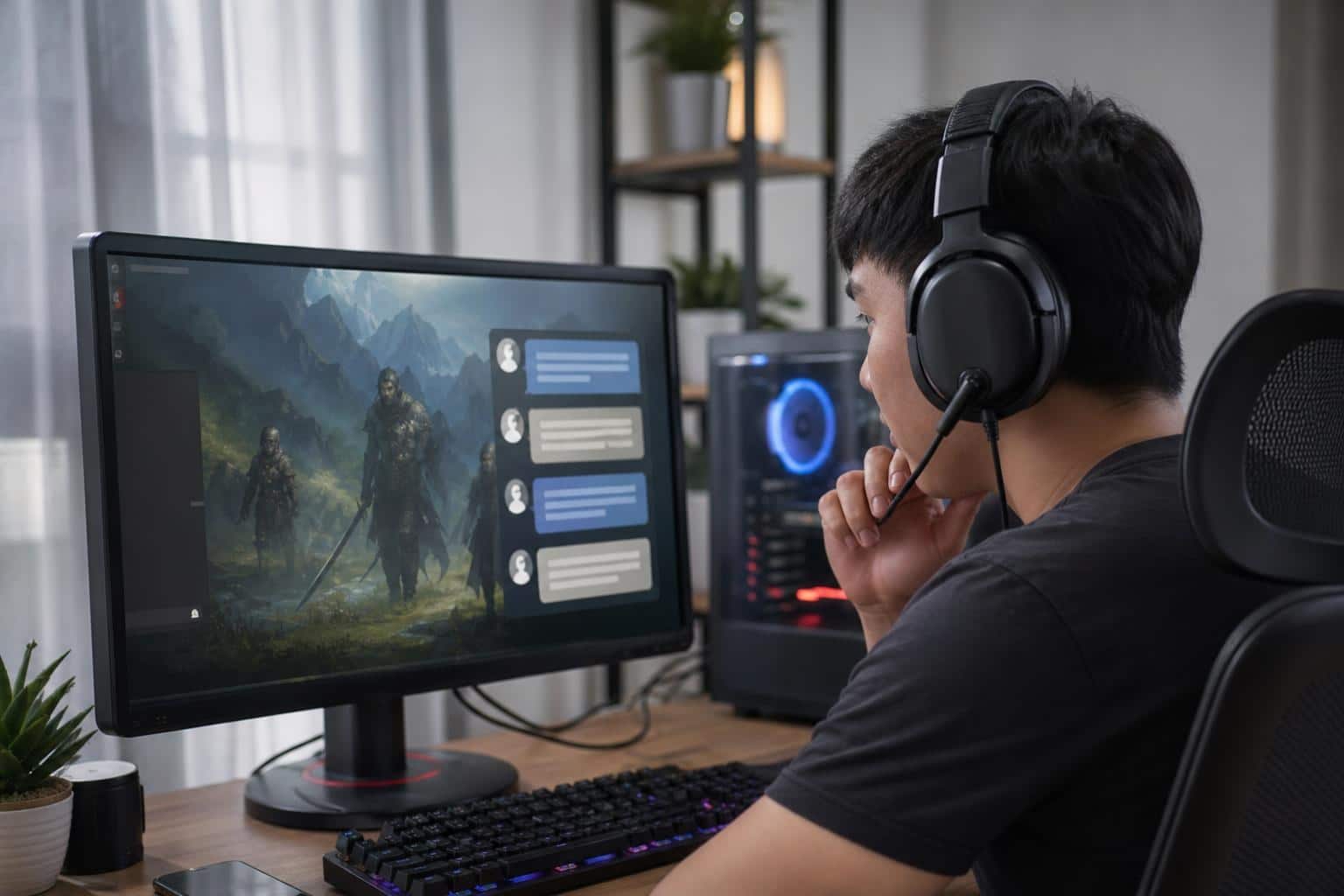
Picture a player in São Paulo whose account gets locked at 2 a.m. local time, right before a ranked tournament. The support team sits in Dublin, works in English, and won’t log on for six hours. By the time someone replies, the tournament is over and the player has probably uninstalled the game.
That situation happens constantly. The audience for most competitive and live-service titles now spans dozens of countries. An online gaming website AI chatbot that handles multilanguage customer support has become one of the more practical fixes for this gap. Below is how studios and platforms are actually using these tools, where they work well, and where human staff still matter.
The Evolution of Global Player Support in Online Gaming
Early PC and console support ran on email tickets and forum threads. If you spoke English, you got help within a few days. If you didn’t, you either used a translation tool yourself or waited for a regional volunteer moderator to notice your post.
Live-service games changed the expectations. Once games began running seasons, battle passes, and real-money storefronts, support turned into a revenue issue as well as a courtesy. A failed purchase or a missing skin needs an answer fast, because a player who feels cheated rarely buys again.
Studios first answered with regional teams, which meant hiring support agents in Korean, Portuguese, German, and Russian. That model works, but it’s expensive and uneven. Smaller languages get thin coverage, night shifts are hard to staff, and patch days flood every queue at once.
The current generation of support blends three layers:
- Self-service help centers with searchable articles in many languages
- AI chatbots that answer common questions and gather account details
- Human agents who take escalated, sensitive, or complicated cases
The chatbot sits in the middle of that stack. It works less as a replacement for staff and more as a filter. It deals with the repetitive load so people can spend their time on cases that need judgment.
Breaking Language Barriers with Real-Time Translation
Language is the hardest problem in global support, and it’s where modern language models have changed the most. Older chatbots relied on scripted decision trees that someone had to translate by hand for each market. Updating one answer meant updating fifteen versions of it.
Current systems can read a message in Turkish, work out what the player wants, and reply in fluent Turkish without any pre-written Turkish script. That shift matters because gaming slang doesn’t translate cleanly. A player typing “I got rubberbanded and the server ate my loot” is describing a desync bug and a lost item. A literal translation turns that sentence into nonsense.
Real-Time Translation for Gaming Helpdesks
The most useful setup I’ve seen pairs live translation with human agents rather than bots alone. A player writes in Polish, the agent sees an English version, the agent replies in English, and the player receives Polish. One English-speaking team can then cover markets it could never staff directly.
A few practical rules make this work:
- Build a glossary of game-specific terms, such as item names, currencies, and modes, so the translation layer never “translates” a proper noun.
- Show agents the original text next to the translation so they can spot mistranslations.
- Flag low-confidence translations for review instead of sending them automatically.
- Keep refund and ban-appeal language reviewed by native speakers, since wording carries legal weight there.
24/7 Global Moderation and Assistance
Time zones create the other half of the language problem. A bot doesn’t sleep, so it can triage reports, answer FAQs, and log incidents during hours when no human is online. For chat moderation, AI can flag harassment across languages in real time. Many offensive terms only make sense inside one culture, though, so regional reviewers still need to confirm borderline calls before penalties stick.
Integrating Virtual Assistants into Game Launchers
Putting a support bot on a website is easy. Putting it where players actually are is harder and pays off more. Most players won’t open a browser to look for a help page. They’ll check the launcher, the in-game menu, or a Discord server.
An assistant built into the launcher has a big advantage: context. It already knows the player’s account, region, platform, installed version, and recent purchases. A player who asks “why won’t it start?” doesn’t need to explain that they’re on Windows, running last week’s patch, and missing a DirectX update. The assistant can check those things and suggest a verify-files step on its own.
Good launcher integrations tend to share a few traits. The chat window opens without closing the game or launcher. It can run simple diagnostics, like connection tests or file verification, with the player’s permission. It hands off to a human ticket with the full conversation attached, so nobody has to repeat themselves.
Privacy deserves real attention here. Players should know what account data the assistant can see. Payment details and personal information should never come up in a chat transcript. Regulations in the EU and elsewhere apply to automated systems just as they do to human agents.
Scalability through Automated Player Support Solutions
Support demand in gaming moves in spikes. A major patch, a server outage, or a new season launch can multiply ticket volume overnight, and most of those tickets ask the same five questions. “Are servers down?” “Where’s my reward?” “Why did my purchase fail?”
Automated player support solutions do well under exactly that kind of load. A bot can answer thousands of identical questions at once, post a status update in every supported language, and collect transaction IDs from players reporting payment issues. Without automation, a team either hires temporary staff who need training or lets response times stretch for days.
The cost math is simple even without precise figures. Each contact a bot resolves fully is one an agent never touches. Each contact it gathers details on before handing off saves the agent several minutes of back-and-forth. Studios usually find the biggest gains in that second category, not in full automation.
One warning: don’t measure the bot only by how many conversations it “deflects.” A bot that sends frustrated players in circles can look efficient on a dashboard while quietly damaging trust. Track whether the issue actually got solved, whether the player came back with the same problem, and how they rated the exchange.
Enhancing Retention with Instant Multilingual Troubleshooting
Retention is where support quality shows up in the business numbers. A player who hits a problem and gets it fixed in two minutes often ends up more loyal than one who never had a problem. A player who waits three days for a reply in a language they barely read usually just leaves.
Instant troubleshooting in the player’s own language removes two kinds of friction at once. The wait disappears, and so does the mental effort of explaining a technical problem in a second language. For a teenager in Indonesia or a casual player in rural Spain, that second part can matter more than speed.
The best multilingual troubleshooting flows are short. They ask one clarifying question at a time, offer clickable fixes instead of paragraphs of instructions, and confirm whether the fix worked before closing the chat. If two attempts fail, they escalate instead of trying a third canned answer.
Reducing Friction in High-Stakes Multiplayer Environments
Competitive modes raise the stakes. When a disconnect costs ranked points or a tournament spot, players want an answer right away and an explanation they trust. An assistant can check server logs, confirm whether a disconnect came from the server side, and explain the game’s compensation policy, such as loss forgiveness, in the player’s language. Ban appeals and cheating accusations are different. They should always reach a human, because a wrong automated decision in those cases generates public anger fast.
The Future of AI-Driven Community Management
Support and community management are starting to merge. The same systems that answer tickets can spot patterns across thousands of conversations. If Brazilian players start reporting the same matchmaking bug within an hour of a patch, community managers can learn about it before it trends on social media.
Expect assistants to grow more proactive over the next few years. Instead of waiting for complaints, they’ll message affected players first: “We detected your purchase didn’t complete, and here’s the refund status.” Voice support inside games will also likely spread, especially on consoles, where typing is slow.
The studios that get this right treat AI as an extension of their team’s voice, not a wall in front of it. They give the bot clear limits, train it on their own policies and terminology, and make reaching a human easy whenever the conversation turns sensitive. They also review transcripts regularly, in every language, because quality problems in smaller markets tend to stay hidden until players start leaving.
If you run support for a gaming platform, start small. Pick your three highest-volume questions and your two largest non-English markets, and automate those well before expanding. A narrow chatbot that solves real problems beats a broad one that answers everything badly. Players remember the night their problem got fixed in their own language, and they come back for the next season.
Leave a Reply